I typically teach the box method when factoring. You can find the link for the box resource here. But this year, I was introduced to what I call the magic method. First, I would like to state how peeved I am that I did not documents this method when I discovered it in high school.
Showing posts with label notes. Show all posts
Tuesday, April 5, 2016
Factoring: The magic method
Sunday, April 3, 2016
Quadrilaterals part 2 (Tons of links to amazing quadrilateral resources)
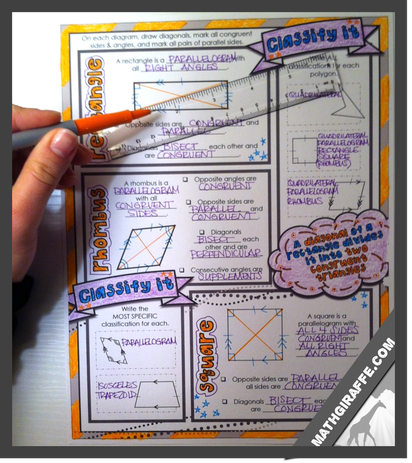
We just finished the quadrilateral unit and my student that rarely does anything made a 72! Whoa! I mean we cannot discuss the child's average, but let's just state that if grades were like golf scores, this kid would be killing it. First, I started with the coloring quadrilateral notes from Math Giraffe. Go sign-up as a follower on her site and you get the doodle notes for free! Umm, yes please. Site link here.

I also paid a few bucks for her coloring quads always, sometimes, never sheet. Again, anytime that is coloring, my kids are down. You can find the link to her store here.
We went on to a classifying activity and most of them knocked it out of the park. I threw in a quiz that day on kahoot! If you have never used Kahoot and you have wifi capable tools in your class, sign up! The kids again, loved it! This whole week was a success lesson wise, if only they were always like that.
Then, as a summary activity we did the bulletin board, found here. I put the kids in groups with giant pieces of bulletin board paper and they worked in teams of 4 putting it together. I made sure I checked it prior to gluing, but a few did it prior to me checking. They only had a few errors, which show that the properties were mastered. We finished up with Kahoot, once more checking to see if they could solve for the missing angle measure.

Study guide and test day were a breeze, thanks to all the wonderful resources available.

I also paid a few bucks for her coloring quads always, sometimes, never sheet. Again, anytime that is coloring, my kids are down. You can find the link to her store here.
We went on to a classifying activity and most of them knocked it out of the park. I threw in a quiz that day on kahoot! If you have never used Kahoot and you have wifi capable tools in your class, sign up! The kids again, loved it! This whole week was a success lesson wise, if only they were always like that.
Then, as a summary activity we did the bulletin board, found here. I put the kids in groups with giant pieces of bulletin board paper and they worked in teams of 4 putting it together. I made sure I checked it prior to gluing, but a few did it prior to me checking. They only had a few errors, which show that the properties were mastered. We finished up with Kahoot, once more checking to see if they could solve for the missing angle measure.

Study guide and test day were a breeze, thanks to all the wonderful resources available.
Tuesday, March 1, 2016
Exponent Rules and Naming Polynomials
I play the video by the Ohio school of mathematical magic. Yes, that is not their name, but play one of their songs in class and BAM. Magic! The kids are humming the tune down the hallway.
I tell students that radical signs remind me of division symbols. We always divide the number "under the hat" (elementary term) by the number on the outside. This time we call it the index. The only thing I had to push hard was the square root is an exponent of 1/2.
These types of questions pop up on the EOC every year. I see kids get overwhelmed by the equation prior to seeing that they can plug it in the calculator. Input major emphasis on these word problems.
Colors are key to learning as visual learners. Tomorrow I will take care of my kinesthetic learners taking another example from Math = Love.
Labels:
algebra,
classifying,
color,
EOC,
exponents,
fun,
high school math,
inb,
learner,
naming,
notes,
polynomials,
radicals,
rational,
South Carolina,
visual
Thursday, February 11, 2016
Geometry: All things Parallel, with a transversal
Okay, while I enjoy teaching Algebra 1 my favorite class is geometry. I cannot state this enough. This includes all of my activities, notes, and games I use teaching parallel lines. My students have have really impressed me with the projects and even the game (considering the lack of enthusiasm for the study guide, go figure).
Let's begin with the notes. I always have students shade in the acute angles one color and the obtuse another color. Then, we put that the angles that are the same color = each other and the opposite colors = 180. This really helps drive home the main two concepts. Then, we discuss the interior vs. exteriors. I hint that same-side starts with an S and so does supplementary. Trying to help them recall the terms as well. The foldable helps them organize the congruent angle relationships compared to the supplementary.
We do a little practice on worksheets, playing review games to get the answers. On to the first project! Design your own city. I love this project, because I get to go over my previous profession in architecture and review urban design. I show them images from my portfolio of how they could one day take this project to design cities. Ya know, get them as excited as I am about the project. I get to even throw in a mini lesson about scale. You can find the rubric I used here. This was not my activity, but I loved the rubric and why re-create the wheel?
Review. Practice. Time for the review game! I didn't want my students that would be all so tempted to keep my real dice, so I had them cut out a template out of paper for the next activity. I had played one similar to this activity before, but this one seemed to work out great. Again, why re-create the wheel? My kids surprised me in how engaged they were. They had the terminology down! We shall see how they do on the test, but right now I am pleased as punch.
We do a little practice on worksheets, playing review games to get the answers. On to the first project! Design your own city. I love this project, because I get to go over my previous profession in architecture and review urban design. I show them images from my portfolio of how they could one day take this project to design cities. Ya know, get them as excited as I am about the project. I get to even throw in a mini lesson about scale. You can find the rubric I used here. This was not my activity, but I loved the rubric and why re-create the wheel?
Review. Practice. Time for the review game! I didn't want my students that would be all so tempted to keep my real dice, so I had them cut out a template out of paper for the next activity. I had played one similar to this activity before, but this one seemed to work out great. Again, why re-create the wheel? My kids surprised me in how engaged they were. They had the terminology down! We shall see how they do on the test, but right now I am pleased as punch.
Labels:
city,
game,
Geometry,
interactive notebook,
lesson,
notes,
parallel lines,
project
Wednesday, February 10, 2016
Geometry Notes: Segment Addition
We have had a nasty virus spreading through the school and therefore I caught it along with my three children. So, I have had plenty of material to post, just no time to post the information. The positive, tons of interactive notebook goodies. Tons of pictures and some good tips that I have learned along the way when teaching geometry.
I was quite surprised my first year teaching how many students need a review of the yellow box.
Segment addition and angle addition work well together in a foldable. I think it helps kids see the same applied math to different shapes.
I was quite surprised my first year teaching how many students need a review of the yellow box.
Wednesday, January 27, 2016
Systems using elimination
Let me just say, wow! The Internet is amazing! I posted that silly donors choose video and bam I have classroom supplies coming straight to my door. The blog had taken to the back burner, but I am back with a few posts. I am going to do two today, the first for my Algebra class, the second for math tech 3/geometry.
I find that substitution is a difficult method to follow out of the three. Unless you are a math nerd like I was in high school and had plenty of experience with math relays. So finally, we come to elimination! I think out of the three forms, minus the calculator for graphing, that this is the easiest form to solve for students. I showed the students how to find the lcm in the calculator (a trick I didn't learn until I went back to school for my master's degree). Go to ALPHA then over to the right to NUM and voila! This menu can factor using the gcd, find the lcm, and plug the absolute value into your calculator. I mean really, why did I not know about this?!
So after teaching the method, I used these worksheets from online. There was one error on the substitution package, but the elimination seemed to be perfect. I had students do the cut out activity as the students homework after the notes were taken. I love this packet because it breaks the material down into steps. The second can be used as a gallery style activity (the way I presented it) or as a matching activity. I loved it! The kids seems to really catch on using elimination. I heard a few complaints from them about the number of steps needed to solve the equations. We are playing a review game and quizzing on the three methods prior to teaching them how to just use a matrix. Man do kids always get mad. "Mrs. P, why did you make us do the other forms? The matrix is soooo easy."
Note: there are limits to using the lcm or the gcd...you can only plug in two numbers and you must keep them positive.
I find that substitution is a difficult method to follow out of the three. Unless you are a math nerd like I was in high school and had plenty of experience with math relays. So finally, we come to elimination! I think out of the three forms, minus the calculator for graphing, that this is the easiest form to solve for students. I showed the students how to find the lcm in the calculator (a trick I didn't learn until I went back to school for my master's degree). Go to ALPHA then over to the right to NUM and voila! This menu can factor using the gcd, find the lcm, and plug the absolute value into your calculator. I mean really, why did I not know about this?!
So after teaching the method, I used these worksheets from online. There was one error on the substitution package, but the elimination seemed to be perfect. I had students do the cut out activity as the students homework after the notes were taken. I love this packet because it breaks the material down into steps. The second can be used as a gallery style activity (the way I presented it) or as a matching activity. I loved it! The kids seems to really catch on using elimination. I heard a few complaints from them about the number of steps needed to solve the equations. We are playing a review game and quizzing on the three methods prior to teaching them how to just use a matrix. Man do kids always get mad. "Mrs. P, why did you make us do the other forms? The matrix is soooo easy."
Note: there are limits to using the lcm or the gcd...you can only plug in two numbers and you must keep them positive.
Subscribe to:
Posts (Atom)